Labyrinth
From Wikipedia, the free encyclopedia
This article is about the maze-like structure from Greek mythology.
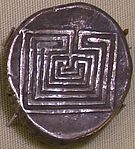
Silver coin from Knossos representing the labyrinth, 400 BC.

Classical labyrinth.

Labyrinth at Meis, Galicia, possibly from the Atlantic Bronze Age

Roman mosaic picturing Theseus and the Minotaur.

Triple spiral labyrinth
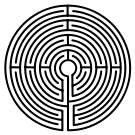
Medieval labyrinth.

A threefold seed pattern with a spiral at the centre.
In Greek mythology, the Labyrinth (Greek λαβύρινθος labyrinthos) was an elaborate structure designed and built by the legendary artificer Daedalus for King Minos of Crete at Knossos. Its function was to hold the Minotaur eventually killed by the hero Theseus. Daedalus had so cunningly made the Labyrinth that he could barely escape it after he built it.

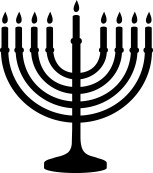
Can you see the similarity between the Greek Labyrinth & the Jewish Menorah ?
Notice the similarity between the words Minotaur & Menorah Tau ?
Ancient labyrinths
Labyrinth is a word of Pre-Greek (Minoan) origin, which the Greeks used for the palace of Knossos in Crete, and it is derived from the Lydian word labrys (“double-edged axe“). This was a symbol of royal power, which suggests that the labyrinth was originally the royal Minoan palace in Crete and meant “palace of the double-axe” (the suffix -nth as in Korinth). This designation may not have been limited to the palace of Knossos, because the same symbols were discovered in other palaces of Crete.
Pliny‘s Natural History mentions four ancient labyrinths: the Cretan labyrinth, an Egyptian labyrinth, a Lemnian labyrinth, and an Italian labyrinth.
‘Labrys’ was a cult-word introduced from Anatolia. In Labraunda of Caria the double-axe accompanies the storm-god Zeus Labrandeus (Ζεὺς Λαβρανδεύς). It also accompanies the Hurrian god of sky and storm Teshub (his Hittite and Luwian name was Tarhun). A lot of these symbols were found in the Minoan palaces in Crete, and they usually accompanied goddesses. It seems that the double-axe was the symbol of the beginning (arche) of the creation.
The goddess of the double-axe probably presided over the Minoan palaces, and especially over the palace of Knossos. The Linear B (Mycenaean) inscription 𐀅𐁆𐀪𐀵𐀍𐄀𐀡𐀴𐀛𐀊 on tablet ΚΝ Gg 702, is interpreted as da-pu2-ri-to-jo,po-ti-ni-ja (labyrinthoio potnia, “Mistress of the labyrinth), and she was undoubtedly the goddess of the palace. The word daburinthos (labyrinthos) may possibly show the same equivocation between initial d- and l- as is found in the variation of the early Hittite royal name Tabarna / Labarna (where written t- may represent phonetic d-).
The complex palace of Knossos in Crete is usually implicated, though the actual dancing ground, depicted in frescoes at Knossos, has not been found. Something was being shown to visitors as a labyrinth at Knossos in the 1st century AD (Philostratos, De vita Apollonii Tyanei iv.34).
The labyrinth is the referent in the familiar Greek patterns of the endlessly running meander, to give the “Greek key” its common modern name. In the 3rd century BC, coins from Knossos were still struck with the labyrinth symbol. The predominant labyrinth form during this period is the simple seven-circuit style known as the classical labyrinth.
https://en.wikipedia.org/wiki/Labyrinth
 This Site Is Secret