Month: February 2016
The Party of JOB ?
The Party of JOB ?

JC

After all
Who doesn’t want a JOB?
Who doesn’t want to do good WORK?
Things are GOOD when they WORK

The Party of BULL ?
The Party of BULL ?
This is not a political blog but how do you arrive at TORY from Conservative anyway?


All members of the Bullying Don Club ?
Most of whom were educated at OX-FORD?
Leading us like cattle to slaughter ?
I hope not. I really do.
If you/we/i are not willing to at least once say “not in my name”
then are you/we/i one of the COW-HERDS ?
There to be “fucked” over by the BULLIES ?
Then let’s say NO …
Say NO to Fracking ! Say NO to Corporate greed
say NO to threats of violence & censorship
that attempt to make ordinary decent people afraid to speak out
“We all burn in eternal fire” or “we’re all born in eternal fear” ?
Which is it?
Will you “burn” or will you become “enlightened” or is it all one in the same?
BRITAIN IS A GREAT COUNTRY FULL OF WONDERFUL PEOPLE
There are GOOD people everywhere. Let us all try & do what is right.
let’s all try & say NO to fear & NO to hate
in whatever guise it comes …
Let’s pull together in friendship solidarity & love
David Cameron is right in once sense
We are all in this together!
We are all in this wonderful, awe-inspiring,
sometimes terrifying, often beautiful & bountiful ride called life!
And sometimes it seems … all we do is argue!
Life can be a wonderful thing if we don’t fall for the Bull …
The Cow of Plenty
The Cow of Plenty
[G]OBNIU, the Smith, had the Cow of Plenty. She walked all over Ireland in a day’s grazing and gave milk to every one that came to her: there was no one hungry or sorrowful in Ireland in those days!
Balor of the Evil Eye set his heart on the Cow. He had the grasping hand that is never filled, and there was nothing good in his country. He sent the best man he had to steal the Cow of Plenty.
The man stole her, but as he was taking her away Gobniu saw him and let out a battle-roar that shook stars from the sky. The man made a leap into the darkness and got off. Gobniu had the Cow, but the Fomorian had the halter. Now, the luck of the world was in the halter, and wherever the halter was the Cow would follow it. Gobniu got little good of the Cow after that! He had to keep his eyes on her, morning, noon, and night, for fear she would go into Balor’s country. He had to tramp behind her when she took her day’s grazing all over Ireland, and the days seemed long to Gobniu the Wonder-Smith.
One day a young champion in a red clock fringed with gold came to him and stood outside his door and saluted him:
“O Wonder-Smith, O Gobniu! will you make a sword for me? It must be long, and keen-edged, and a death-biter–a sword for a champion. Will you make it, Gobniu? No Smith in Ireland can make a sword for champion-feats but yourself!”
“It’s little trouble I would have with the sword, young champion, but I must follow my Cow from morning till night. If once I took my eyes off her, she would go to Balor in the land of the Fomor.”
“If you make the sword for me I will follow the Cow from morning till night and never take my eyes off her once.”
“If you do that, Cian, son of Dian-Cecht, I will make the sword.”
It was agreed between them, and the Smith set to the making of the sword while Cian followed the Cow. She walked all over Ireland that day, and Cian was not sorry when she came at night to the house of Gobniu. There was light within, and some men stood at the door. They said to Cian:
“The Wonder-Smith has made the sword for you, and waits to put the tempering on it: he can’t do that till you go within and hold the sword hilt.”
It was a joy to Cian to hear this, and he ran in quickly.
“Where is the Cow? ” said the Smith.
“She is without,” said Cian; “my head to you if she is not!”
“She is not without,” said the Smith, “she is with Balor!” and he ran to the door. The Cow was gone!
“I have only my head to give you now, O Gobniu!”
“I will not take your head, Cian, son of DianCecht, but I will take another eric from you. Go now in search of the halter; it is with Balor in the land of the Fomorians. The road is hard to find that leads there and the dark waters are ill to cross, but do not turn back or leave off seeking till you get the halter of the Cow.”
I will not come back to Ireland,” said Cian, “without the halter of the Cow.”
Cian set out and he travelled and travelled till he came to the dark waters, and when he came to them he could find no boat to cross. He waited there for three days and nights searching for a boat, and then he saw a small poor-looking boat with an old man in it. Cian looked at the boat, but, although he was a good champion and had cleverness, he did not know that he was looking at the Ocean-Sweeper, the boat that could carry any one in a moment to whatever place they wished to be; and he did not know that the old man was the Tawny Mananaun, the Son of Lear, who rules all the oceans of the world.
“Old man,” said Cian, “will you row me across the waters to the land of Balor? “
“I will row you, young champion, if you swear to give me half of what you gain there.”
“I will share everything with you but the halter of Gobniu’s Cow.”
I will not ask for that,” said the boatman.
“Be it so,” said the other. They stepped into the boat, and in a moment they touched the land of the Fomor.
“You have helped me in need, old man,” said Cian. “I have a gold ring, and my cloak is rich–I pray you keep them both.”
“I will change cloaks,” said the old man, “but I will not take the ring.” He put his hand on Cian’s fingers. “I leave you a gift,” he said, “whatever lock you touch will open before you. He put his cloak on Cian’s shoulders. “It covers you as night covers the earth–beneath it you are safe, for no one can see you.”
The cloak fell about Cian in long folds; he knew there was magic in it and turned to look closely at the old man, but he could not see him and the boat was gone.
Cian was in a strange country, all cold, and desolate, and death-looking; he saw fierce warriors of the Fomor, but the cloak sheltered him and he reached the court of Balor without mishap.
“What seek you of me? ” said Balor.
“I would take service with you,” said Cian.
“What can you do?”
“Whatever the De Danaans can do,” said Cian. “I could make grass grow in this land, where grass never grew.”
Balor looked pleased when he heard that, for he had the greatest desire in the world for a garth of apple trees like the apple trees Mananaun had in the Island of Avilion, that were so beautiful people made songs about them.
“Can you make apple trees grow? ” said he to Cian.
“I can,” said Cian.
“Well,” said Balor, “make me a garth of apple trees like the garth Mananaun has; and when I see apples on the trees I will give you your own asking of reward.”
“I have only one reward to ask,” said Cian, “and I will ask for it at the beginning; it is the halter of Gobniu’s Cow.”
“I will give you that,” said Balor, “without deceit.”
Cian was glad when he made the bargain, and he began to work; he had his sufficiency of trouble over the grass, for every blade that grew for him in the morning was withered by Balor’s breath at night. After a while he had apple trees, and as he used to be minding them he often looked at a great white dun that was near. Warriors of the Fomorians were always guarding it, and one day he asked who it was lived there.
“Ethlinn, Balor’s daughter, lives there,” said the man he asked. “She is the most beautiful woman in the world, but no one may see her, and she is shut in the dun lest she should marry, for it is said that a son born of her will slay Balor.”
Cian kept thinking of this, and there was a wish on him to see the beautiful woman. He put the magic cloak on him and went to the dun. When he laid his hand on the door it opened, because of the enchantment on his fingers. He went in and found Balor’s daughter. She was sitting at a loom, weaving a cloth that had every colour in it, and singing as she wove. Cian stood awhile looking at her till she said:
“Who is here that I cannot see?”
Then he dropped the cloak. Balor’s daughter loved him when she saw him, and chose him for her man. He came to her many times after that, and they took oaths of faithfulness to one another. There was a child born to them, and he was so beautiful that whatever place he was in seemed to be full of sunshine. Ethlinn, his mother, called him Lugh, which means Light, but Cian, his father, used to call him the Sun-God; and both names stuck to him, but Lugh was the name he was best known by.
Now Balor was watching the apple trees, and when he saw apples on them he brought the halter of Gobniu’s Cow to his daughter, and said:
“Hide this, and when I am asked for it, it will be gone from me.”
Balor’s daughter took the halter, and a little afterwards Cian came to her with a branch of apples.
“The first apples for you!” he said.
She gave him the halter.
“Take it–and the child, and go away to the land you came from.”
“That is a hard saying!” said Cian.
“There is nothing else to do,” said she.
Cian took the child and the halter, and wrapped his cloak about him. He said farewell to Balor’s daughter and went till he came to the dark waters. A boat was there before him and the old man in it. Cian thought they were a short time in crossing.
“Do you remember our bargain? “said the old man.
“I do,” said Cian, “but I have nothing but the halter and this child–I will not make two halves of him.”
“I had your word on it!” said the old man.
“I will give you the child,” said Cian.
“You will never be sorry for it,” said the old man, “for I will foster him and bring him up like my own son.”
The boat touched the land of Ireland.
“Here is your cloak,” said Cian, “and take the child.”
Mananaun took the little child in his arms, and Cian put the cloak about him, and when he shook it out it had every colour of the sea in it and a sound like the waves when they break on a shore with the music of bells. The old man was beautiful and wonderful to look at, and Cian cried out to him:
“I know you now, Mananaun Mac Lear, and it was in a lucky hour I gave my son to you, for he will be brought up in Tir-nan-Oge, and will never know sorrow or defeat!”
Mananaun laughed and lifted the little Sun-God high up in his two hands.
“When you see him again, Cian, son of Dian-Cecht, he will be riding on my own white horse and no one will bar his way on land or sea. Now, take farewell of him, and may gladness and victory be with you!”
Mananaun stepped into the boat; it was shining with every colour of the rainbow as clear as crystal, and it went without oars or sails with the water curling round the sides of it and the little fishes of the sea swimming before and behind it.
Cian set his face towards the house of Gobniu, the Smith. He came to it, and he had the halter in his hand, and when he came the Cow was there before him and Gobniu came out to meet him.
“A welcome before you, young champion, and may everything you undertake have a happy ending!”
“The same wish to yourself!” said Cian, and gave him the halter. The Smith gave Cian the sword then, and there was gladness and friendship between them ever after.
http://www.sacred-texts.com/neu/celt/cwt/cwt06.htm
Could we identify Cian with Cain ? Balor with Baal ?
& by now we should be getting a good idea who the Cow Of Plenty is
Protected: The Irish Connection
MASONS MACES & GNOSIS
MASONS, MACES & GNOSIS
So we’ve talked (torqued) a fair bit about the connection between The Neolithic/Bronze Age Bull Cults & The Age Of Taurus (sign of The Bull) & how this all ties into a date of about 6480 years ago.

These days (daze) we hear a lot about the Masons. The Master Builders. How far back then do the Masons go & how do they fit into all this?
Most would agree that our modern day Masons had their counter-parts way back in the mists of time also.
It’s fairly well known that the Masons themselves trace their origins back to Egypt & to the Biblical Tubal Cain – who was said to have given man knowledge of Metal working :
New International Version
Zillah also had a son, Tubal-Cain, who forged all kinds of tools out of bronze and iron.
Tubal-cain is a person mentioned in the Hebrew Bible, in Genesis 4:22. He was a descendant of Cain, the son of Lamech and Zillah, the brother of Naamah and half-brother of Jabal and Jubal.
Occupation
Genesis 4:22 says that Tubal-cain was the “forger of all instruments of bronze and iron” (ESV) or an “instructor of every artificer in brass and iron” (KJV). Although this may mean he was a metalsmith, a comparison with verses 20 and 21 suggests that he may have been the very first artificer in brass and iron. T. C. Mitchell suggests that he “discovered the possibilities of cold forging native copper and meteoric iron.”[4] Tubal-cain has even been described as the first chemist.
Others connect Tubal-cain’s work to making weapons of war. Rashi notes that he “spiced and refined the Cain’s craft to make weapons for murderers.”In The Antiquities of the Jews, Flavius Josephus says that “Tubal exceeded all men in strength, and was very expert and famous in martial performances, … and first of all invented the art of working brass.”[citation needed] Walter Elwell suggests that his invention of superior weapons may have been the motivation for Lamech‘s interest in avenging blood.
Alternatively, E. E. Kellett suggests that Tubal-cain may have been a miner
https://en.wikipedia.org/wiki/Tubal-cain
However I wonder if we can perhaps trace their lineage back even further simply by looking at the word Masons itself : MASONS = SONS OF THE MACE
Mace (weapon), a weapon with a heavy head on a solid shaft used to bludgeon opponents Ceremonial mace, an ornamented mace used in civic ceremonies

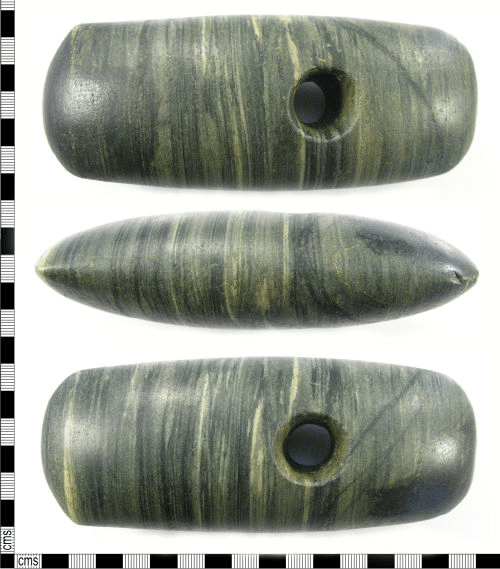
A Neolithic Mace Head.
I kept having a recurring dream. It came to me a while back that what with all the Taurus connections to the neolithic (6480 years ago) perhaps the so-called Masons (the builders) went back that far as well. It struck me (pun intended) that there might possibly be a connection between the word MASON & the word Mace . It has been discovered through the archaeological record that one way of identifying seemingly Kingly or priestly burials was by the finding of the (supposedly) highly esteemed ornamental Axe heads or MACE heads contained with the grave goods.
My dream was instructing me to look into a connection between Onyx & Mace heads because if we conflate the two words we get Mace Onyx (or Masonic) one who carries the Onyx Mace head.
Iconic (I see onyx)
Well, whilst researching I came across the above item. Okay I grant you – this is not made from Onyx but I still found it interesting as it is apparently made of Gneiss which to me sounds a bit like Gnosis (or Knossos or Genesis)
Gneiss
Gneiss is a high grade metamorphic rock, meaning that it has been subjected to higher temperatures and pressures than schist. It is formed by the metamorphosis of granite, or sedimentary rock. Gneiss displays distinct foliation, representing alternating layers composed of different minerals.
Interesting that it should be described as a metamorphic rock!
Notice (gnosis) the similarity between the word Gneiss & Genesis & Gnosis & Knossos
GREEN ONYX
What are the healing properties of Green Onyx stone? The Green Onyx is the symbol of restfulness and purity. This green soothing stone has the power to relief you all worries, tension, stress and fears.
I’ve done a few searches & can’t find anything to suggest that Mace Heads were ever made from Onyx (probably far too brittle) so I think I am barking up the wrong tree there. However, the connection between Gneiss & mace heads is in & of itself fascinating.
Labrys
Labrys
From Wikipedia, the free encyclopedia

An ornamented golden Minoan labrys
Labrys (Greek: λάβρυς, lábrys) is the term for a symmetrical double-bitted axe originally from Crete in Greece, one of the oldest symbols of Greek civilization; to the Romans, it was known as a bipennis. The symbol was commonly associated with female divinities.
The double-bitted axe remains a forestry tool to this day, and the labrys certainly functioned as a tool and hewing axe before it was invested with symbolic function. Labrys symbolism is found in Minoan, Thracian, and Greek religion, mythology, and art, dating from the Middle Bronze Age onwards, and surviving in the Byzantine Empire.
Etymology
Plutarch relates the word labrys with a Lydian word for “axe”: (Λυδοὶ γὰρ ‘λάβρυν’ τὸν πέλεκυν ὀνομάζουσι). R. S. P. Beekes rejected an Indo-European etymology and proposed a Pre-Greek one; he also suggested that labrys has the same root as labyrinthos.
Labrys was a cult-word that was introduced from Anatolia, where such symbols have been found in Çatal Höyük from the neolithic age.[citation needed] In Labraunda of Caria the double-axe accompanies the storm-god Zeus Labraundos. In Crete, the symbol of the double-axe always accompanies goddesses, and it seems that it was the symbol of the beginning (arche) of the creation. The word labyrinth, which the Greeks used for the palace of Knossos is possibly derived from labrys. It seems that the goddess of the double-axe presided over the Minoan palaces, and especially over the palace of Knossos. The Linear B (Mycenaean) inscription 𐀅𐁆𐀪𐀵𐀍𐀡𐀴𐀛𐀊, on tablet ΚΝ Gg 702, is interpreted as da-pu2-ri-to-jo-po-ti-ni-ja (labyrinthoio potnia, “Mistress of the labyrinth), and she was undoubtedly the goddess of the palace.
However the designation “The house of the Double Axe” cannot be limited to the palace of Knossos, because the same symbols were discovered in other palaces of Crete.
The priests at Delphi in classical Greece were called Labryades (the men of the double axe). Evans’ article supplies the first citation of the word in the Oxford English Dictionary (OED).
Minoan civilization
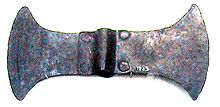
Bronze axe from the Mesara tombs
The Labrys is most closely associated in historical records with the Minoan civilization which reached its peak in the 2nd millennium BC, and specifically with the worship of a goddess. In Crete the symbol always accompanies female divinities and it was probably the symbol of the arche of the creation (Mater-arche:matriarchy).
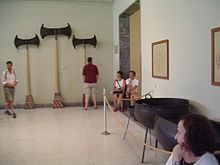
Double axes taller than a human
Some Minoan labrys have been found which are taller than a human and which might have been used during sacrifices. The sacrifices would likely have been of bulls. The bull and double-axe are seen in Çatalhöyük as well, which existed from 7500 BC to 5700 BC. The labrys symbol has been found widely in the Bronze Age archaeological recovery at the Palace of Knossos on Crete. According to archaeological finds on Crete this double-axe was used specifically by Minoan priestesses for ceremonial uses.[citation needed] Sometimes the double-axe is combined with the sacral-knot which seems that was a symbol of holiness. Such symbols have been found in Crete, and also on some gold rings from Mycenae.
Several double axes were found at the Arkalochori cave in Crete, with inscriptions in the Linear A script. A golden axe assumed to be from Alkalochori is now exhibited in the Museum of Fine Arts in Boston. Among the double axes, the second-millennium bronze Arkalochori Axe with an inscription was excavated by Marinatos in 1934. It has been suggested that these might be Linear A but it seems that “the characters on the axe are no more than a ‘pseudo-inscription’ engraved by an illiterate in uncomprehending imitation of authentic Linear A characters on other similar axes.”
In the Near East and other parts of the region, eventually axes of this sort are often wielded by male divinities and appear to become symbols of the thunderbolt. In Labraunda of Caria the double-axe accompanies the storm-god Zeus Labraundos. Similar symbols have been found on plates of Linear pottery culture in Romania.
The double-axe is associated with the Hurrian god of sky and storm Teshub. His Hittite and Luwian name was Tarhun. Both are depicted holding a triple thunderbolt, and a double axe on the other hand. Similarly, Zeus throws his Keravnos to bring storm. The labrys, or pelekys, is the double axe Zeus uses to invoke storm, and the relative modern Greek word for lightning is star-axe (ἀστροπελέκι astropeleki) The worship of it was kept up in the Greek island of Tenedos and in several cities in the south-west of former Hellenic Asia Minor, and it appears in later historical times in the cult of the thundergod of Asia Minor (Zeus Labrayndeus).
In feminist interpretations, it is a symbol of matriarchy. It may also be interpreted as a butterfly based on the Minoan butterfly goddesses shown in the shape of a labrys. The double-axe is also associated with the Greek fire god Hephaestus, so to the Minoans the labrys may have been associated with a fire goddess, possibly similar to Hestia.
Ancient Greece
The word labyrinthos (Mycenaean daburinthos) is possibly connected with the word labrys. In the Linear B (Mycenean Greek) script a symbol similar to a double-axe represents the phonetic sign a. In the context of the Classical Greek myth of Theseus, the labyrinth of Greek mythology is frequently associated with the Minoan palace of Knossos and has a long tradition of use that extends before any written records explain the traditions.
On Greek vase paintings, a labrys sometimes appears in scenes of animal sacrifice, particularly as a weapon for the slaying of bulls.
On the “Perseus Vase” in Berlin (F1704; ca 570–560 BC), Hephaestus ritually flees his act of slicing open the head of Zeus to free Athena whose pregnant mother Zeus swallowed to prevent her offspring from dethroning him. Over the shoulder of Hephaestus is the instrument he has used, the double-headed axe. The more usual double-headed instrument of Hephaestus is the double-headed smith’s hammer so the symbolism is important. Zeus swallowing the goddess symbolized the progressive suppression of the earlier traditional religious beliefs, symbolically dethroning the goddess, Metis, but allowing Athene (her daughter) to be “born” of Zeus because her worship was so pervasive and widespread that it could not be suppressed. That is likely the reason the labrys was depicted as the instrument used by Hephaestus (who much earlier had been a consort of the Earth goddess) to release Athene.
On Greek coins of the classical period (e.g. Pixodauros, etc.) a type of Zeus venerated at Labraunda in Caria that numismatists call Zeus Labraundeus (Ζεὺς Λαβρανδεύς) stands with a tall lotus-tipped sceptre upright in his left hand and the double-headed axe over his right shoulder.
The double-axe also appears in Thracian art. On the Aleksandrovo kurgan fresco, it is probably wielded by Zalmoxis.
Into The Labyrinth
Labyrinth
From Wikipedia, the free encyclopedia
This article is about the maze-like structure from Greek mythology.
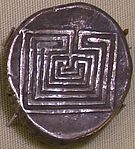
Silver coin from Knossos representing the labyrinth, 400 BC.

Classical labyrinth.

Labyrinth at Meis, Galicia, possibly from the Atlantic Bronze Age

Roman mosaic picturing Theseus and the Minotaur.

Triple spiral labyrinth
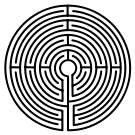
Medieval labyrinth.

A threefold seed pattern with a spiral at the centre.
In Greek mythology, the Labyrinth (Greek λαβύρινθος labyrinthos) was an elaborate structure designed and built by the legendary artificer Daedalus for King Minos of Crete at Knossos. Its function was to hold the Minotaur eventually killed by the hero Theseus. Daedalus had so cunningly made the Labyrinth that he could barely escape it after he built it.

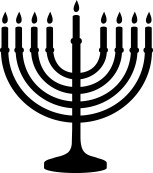
Can you see the similarity between the Greek Labyrinth & the Jewish Menorah ?
Notice the similarity between the words Minotaur & Menorah Tau ?
Ancient labyrinths
Labyrinth is a word of Pre-Greek (Minoan) origin, which the Greeks used for the palace of Knossos in Crete, and it is derived from the Lydian word labrys (“double-edged axe“). This was a symbol of royal power, which suggests that the labyrinth was originally the royal Minoan palace in Crete and meant “palace of the double-axe” (the suffix -nth as in Korinth). This designation may not have been limited to the palace of Knossos, because the same symbols were discovered in other palaces of Crete.
Pliny‘s Natural History mentions four ancient labyrinths: the Cretan labyrinth, an Egyptian labyrinth, a Lemnian labyrinth, and an Italian labyrinth.
‘Labrys’ was a cult-word introduced from Anatolia. In Labraunda of Caria the double-axe accompanies the storm-god Zeus Labrandeus (Ζεὺς Λαβρανδεύς). It also accompanies the Hurrian god of sky and storm Teshub (his Hittite and Luwian name was Tarhun). A lot of these symbols were found in the Minoan palaces in Crete, and they usually accompanied goddesses. It seems that the double-axe was the symbol of the beginning (arche) of the creation.
The goddess of the double-axe probably presided over the Minoan palaces, and especially over the palace of Knossos. The Linear B (Mycenaean) inscription 𐀅𐁆𐀪𐀵𐀍𐄀𐀡𐀴𐀛𐀊 on tablet ΚΝ Gg 702, is interpreted as da-pu2-ri-to-jo,po-ti-ni-ja (labyrinthoio potnia, “Mistress of the labyrinth), and she was undoubtedly the goddess of the palace. The word daburinthos (labyrinthos) may possibly show the same equivocation between initial d- and l- as is found in the variation of the early Hittite royal name Tabarna / Labarna (where written t- may represent phonetic d-).
The complex palace of Knossos in Crete is usually implicated, though the actual dancing ground, depicted in frescoes at Knossos, has not been found. Something was being shown to visitors as a labyrinth at Knossos in the 1st century AD (Philostratos, De vita Apollonii Tyanei iv.34).
The labyrinth is the referent in the familiar Greek patterns of the endlessly running meander, to give the “Greek key” its common modern name. In the 3rd century BC, coins from Knossos were still struck with the labyrinth symbol. The predominant labyrinth form during this period is the simple seven-circuit style known as the classical labyrinth.
https://en.wikipedia.org/wiki/Labyrinth
Bull Leaping (Is The Earth Only 6,500 years old?)
Is the Earth really only 6,500 years old?
Young Earth proponents say that the World is about 6,500 years old whereas everyone else says it’s very much older. perhaps both of these positions have validity
Here’s how it could work.
Obviously geologically speaking The Earth is very much older than 6,500 years. However, if we use the Great Celestial Year of 25,920 Earth years (the time it takes to do one complete cycle of all 12 Houses of The Zodiac) then let’s see what happens counting back from now which we assume to be somewhere on the cusp of the transition from the end of The Age of Pisces to the beginning of The Age Of Aquarius
If we divide the Great Year by the 12 Ages of The Zodiac we get 2160 years for each age.
Now = 0 (the present day)
count back 2160 years to the start of The Age of Pisces (& end of The Age of Aires)
count back 4320 years to the start of The Age Of Aires (& end of The Age of Taurus)
count back 6480 years to the start of The Age of Taurus (& end of The Age of Gemini)
So now we have gone back approx 6,500 years to the start of The Age Of Taurus.
By the Mesolithic period from 10,000 to 6,500 years ago people were making temporary settlements – winter and summer camps. However, the lifestyle was still one of hunter-gathering combined with a new skill – fishing. As the last ice retreated, the climate gradually warmed, which allowed the early tundra to develop into scrub, then birch rapidly followed by pine forest, in turn followed by mixed deciduous woodland consisting of oak, elm, elder and lime by 10,000 years ago. The beech trees that are so distinctive a feature of the area today, came along at a later date and were not a feature of this early landscape. Together with the establishment of vegetation came the grazing animals and their predators: red and roe deer, wild boar, wolves, foxes, a wealth of rodents and other small mammals, plus the auroch (an early form of the domestic cow, but huge in size) and the elk. Along with these animals came people from . By about 8,500 years ago the entire ice sheet had melted sufficiently to raise sea-level significantly and the was cut off from the continent. This allowed an indigenous population to develop from this point onwards. There have been no Mesolithic finds on Downley, but a nearby hilltop location at Cadmore End has been shown to contain tools from Mesolithic hunting parties. These parties were very likely to have travelled to the wooded heights from Marlow as the river valley there was well populated in the Mesolithic period. There are literally hundreds of flint implements found along the River Thames, many on the banks or within adjacent gravels. In addition to Marlow, neighbouring Medmenham, Bourne End, Fawley, Taplow and Hedsor all have large amounts of Mesolithic finds.
http://www.chilternarchaeology.com/palaeo_to_neolithic.htm
Glacial Retreat of 5,000-7,000 Years Ago
Bible ‘clue’ found
So, it would appear that something BIG happened about 7,000 years ago. Something connected to the final retreat of the Ice & involving large amounts of water
Chronology
The term Neolithic or New Stone Age is most frequently used in connection with agriculture, which is the time when cereal cultivation and animal domestication was introduced. Because agriculture developed at different times in different regions of the world, there is no single date for the beginning of the Neolithic. In the Near East, agriculture was developed around 9,000 BCE, in Southeast Europe around 7,000 BCE, and later in other regions. Even within a specific region, agriculture developed during different times. For example, agriculture first developed in Southeast Europe about 7,000 BCE, in Central Europe about 5,500 BCE, and Northern Europe about 4,000 BCE. In East Asia, the Neolithic goes from 6000 to 2000 BCE.
Neolithic 3 – Pottery Neolithic (PN)
The Neolithic 3 (PN) began around 6,400 BCE in the Fertile Crescent. By then distinctive cultures emerged, with pottery like the Halafian (Turkey, Syria, Northern Mesopotamia) and Ubaid (Southern Mesopotamia). This period has been further divided into PNA (Pottery Neolithic A) and PNB (Pottery Neolithic B) at some sites.
The Chalcolithic period began about 4500 BCE, then the Bronze Age began about 3500 BCE, replacing the Neolithic cultures
https://en.wikipedia.org/wiki/Neolithic
Essentially then the beginning of The Age Of Taurus coincides more or less with the beginning of The Neolithic in Europe after the Flood Waters retreated. The Neolithic was when we settled down & started farming & keeping Cattle & wealth was (judging by the Ancient Tales) largely counted in Cattle. TAURUS is the sign of The Bull & this coincides with when we transform from an essentially Mesolithic Culture into a Neolithic Culture.
(I have a thesis) …..
Legends of Knossos
Main article: Labyrinth
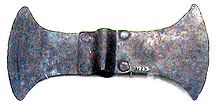
DOUBLE AXE HEAD (Double OX head)
In Greek mythology, King Minos dwelt in a palace at Knossos. He had Daedalus construct a labyrinth (by some connected with the double-bladed axe, or labrys) in which to retain his son, the Minotaur. Daedalus also built a dancing floor for Queen Ariadne (Homer, Iliad 18.590-2). The name “Knossos” was subsequently adopted by Arthur Evans because it seemed to fit the local archaeology. The identification has never been credibly questioned, mainly because of that archaeology.
https://en.wikipedia.org/wiki/Knossos
The Minotaur dwelt at the centre of the Labyrinth, which was an elaborate maze-like construction designed by the architect Daedalus and his son Icarus, on the command of King Minos of Crete. The Minotaur was eventually killed by the Athenian hero Theseus.
Minor TAU (r)
In Hebrew the Aleph (represented by The Bull or Ox) is the first letter. TAU is the last or 22nd letter of the Alphabet (Tau can be represented by an X)
http://www.immaculatasfo.org/documents/Tau%20Cross.pdf
The image of the Hebrew letter Aleph is an ox.
The image of the latter Tau (Tav) is a cross mark. The cross is a very ancient symbol, its most basic meaning is that of the division of the universe into four directions, by this it encloses the universe in its entirety.
Tau is the summary of everything in everything. As the hundreds in the Hebrew alphabet represent the physical world, Tau, as the last letter, represents the furthest development in the physical world. Its numerical value is 400, and it is used to indicate infinity.
So the OX (Aleph) to X (Tau) is both FIRST & LAST but we know that actually TAURUS is NOT all there is. It is just one quarter of the Circle (NOT the HOLE or WHOLE) so how can this be?
Is it all then essentially a LIE of the BULL GOD?
(A “god” of deception? Or as we say these days “BULL” ? )
Or as an Atheist might claim “A load of old BULL” ?
Have we eaten too much BULLY beef? Have we all collectively been suffering from a form of Mad Cows Disease for the last 6,500 years – causing us to compete? To continually go to war & kill each other?
Well, study History for an answer to that question.
Can we grab the BULL by the Horns & leap over & see past the BULL ?
Sacred BULLS & Ancient Bull Worship
Now, before anyone accuses me of being anti- well, anti-anybody. This is not about any one race or group of people. To try & blame all the ills of the world on any particular “race” of people is PATENTLY ABSURD! People sometimes do wrong but even then they are not always to blame (for “they know not what they do“) As we follow the evidence through, past the Hebrew, past the Zionist, past Knossos, past the Phoneticians, perhaps we will come to see that ALL / EL (time itself) is illusory. But along the way maybe we shall answer the FEMA paradox & through acceptance of the existence of higher powers & higher dimensionality we shall hopefully come to accept ourselves & love each other whilst also recognizing that JESUS was spot on with his advice to live a good life.
( of course many people already do do this!)
Remember we are all half man half bull. The BULL is in us & we are in the BULL.
As we try to conquer & tame our Animal Nature
To take things back a little further :
The Pleistocene Epoch is typically defined as the time period that began about 1.8 million years ago and lasted until about 11,700 years ago. The most recent Ice Age occurred then, as glaciers covered huge parts of the planet Earth. (smack in the middle of the Age of LEO) Remember that LEO resonates at 512 hz which = 8x8x8 & some say the 23.4 TILT OF THE EARTH happened at this time.
 This Site Is Secret